
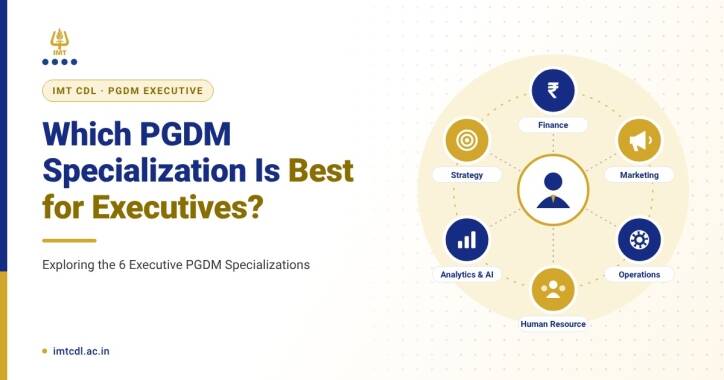
When experienced managers decide to move into leadership roles, they often ask themselves – which PGDM specialization is best for executives. Many online guides give answers: “Pick this field because it pays the most” or “Choose that field because it is popular now.”
Choosing a specialization is not about guessing short-term industry trends. It is a decision about the business problems executives want to solve the operational capabilities executives need to build and the organizational responsibilities executives want to own. For working professionals, determining the PGDM specialization connects three key factors: existing work experience skills still needed and the leadership role executives want over the next three to five years.
Table of Contents
- Focus on the Role Rather than the Subject
- Exploring the 6 Executive PGDM Specializations
- 1. Finance: Capital Allocation & Financial Leadership
- 2. Marketing: Customer Acquisition & Revenue Growth
- 3. Operations: Process Scale & Supply Chain Resilience
- 4. Human Resource: Talent Strategy & Organizational Design
- 5. Business Analytics and AI: Evidence-Based Executive Decision Making
- 6. Strategy and Innovation: Cross-Functional Enterprise Direction
- Avoid 3 Common Mistakes When Choosing Executive PGDM Specializations
- Use A Simple Scorecard to Determine the Best PGDM Specialization for You
- Frequently Asked Questions
Focus on the Role Rather than the Subject
Before asking which PGDM specialization is best, look closely at what executives want to be accountable for in their position. Leading an enterprise requires types of managerial depth depending on the functional area:
Capital & Value Creation: Overseeing financial performance, capital allocation, corporate risk and budget governance.
Brand Strategy: Driving market share, sales pipelines, product positioning and revenue generation.
Operational Resilience: Improving supply chains, manufacturing efficiency, tech delivery and service operations.
Workforce Culture: Aligning talent acquisition, retention, executive training and organizational design with company objectives.
Data-Led Decision Making: Using models and modern analytics tools to improve operational choices.
Enterprise Transformation: Shaping strategy, new market entry and cross-functional leadership.
Exploring the 6 Executive PGDM Specializations
In an AICTE-approved 15-month format each track gives experienced managers practical decision-grade skills. Here is a clear breakdown of how each PGDM specialization aligns with career trajectory:
1. Finance: Capital Allocation & Financial Leadership
If you are moving toward roles where every major decision impacts the line, Finance provides the structural clarity you need. It strips away accounting jargon. Focuses on how capital moves through an organization – how investments are evaluated, how working capital is kept healthy and how corporate risk is managed in volatile markets.
Where this path takes you: Prepares you for treasury, commercial banking, portfolio management and general management roles requiring direct P&L accountability and board-level budget defense.
What you actually study: Business valuation, corporate financial analysis, investment modeling, risk assessment frameworks and financial analytics.
Explore the Executive Programme in Finance and discover the curriculum, learning approach and programme details.
2. Marketing: Customer Acquisition & Revenue Growth
Tactical marketing focuses on running campaigns. executive marketing focuses on driving business growth. This pathway bridges the gap between customer psychology and balance sheet revenue showing you how to build commercial channels, establish pricing leverage and lead enterprise sales teams.
Who benefits most: Experienced sales leads, product marketing managers and client servicing specialists ready to step out of campaign execution and overarching go-to-market strategies.
The toolkit you walk away with: Consumer behavior analytics, -channel distribution strategy, value-based pricing and integrated digital marketing architecture.
3. Operations: Process Scale & Supply Chain Resilience
A business strategy collapses without dependable execution. The Operations track is engineered for professionals tasked with keeping business engines running smoothly – transforming manufacturing, tech delivery, logistics and service operations into lean scalable systems.
Target professional profile: Supply chain planners, project directors, technical leads and manufacturing managers aiming to lead plant operations, regional distribution or operational excellence teams.
Hands-on focus areas: Six-sigma workflow design, supply chain risk mitigation, service operations modeling, quality assurance systems and enterprise tech integration.
If you’re interested in understanding how businesses run through logistics, supply chains, the executive programme in Operations Management could be the right choice for you.
4. Human Resource: Talent Strategy & Organizational Design
Human resource leadership has evolved beyond operational payroll and policy compliance. This track is built around alignment ensuring talent acquisition, executive development and company culture directly support strategic commercial goals.
The next step in your career: Designed for HR practitioners and functional team leaders stepping into HR Business Partner (HRBP) leadership people operations or organizational development roles.
Practical business impact: workforce planning, executive talent retention organizational restructuring, modern labor dynamics and data-backed HR analytics.
5. Business Analytics and AI: Evidence-Based Executive Decision Making
Data is only valuable if it leads to business choices. This specialization is designed to help managers cut through noise, bridge the gap between engineering teams and business leadership and use predictive models to make informed defensible decisions.
Ideal for your background: Mid-career managers, software engineers who need to translate data into strategic business insights for executive stakeholders.
Analytical methods: Practical exposure to Power BI, Advanced Excel modeling, predictive business forecasting, data storytelling and the safe responsible adoption of AI tools in business operations.
6. Strategy and Innovation: Cross-Functional Enterprise Direction
When you reach management, excelling within a single department is no longer enough. The Strategy and Innovation pathway gives you a lens on the entire organization helping you identify new market opportunities lead cross-functional transformations and outmaneuver competitors.
Your target horizon: Senior managers and business unit heads with 5+ years of experience preparing to assume business ownership or direct enterprise growth initiatives.
Strategic capabilities gained: positioning, scenario planning, design thinking, strategic resource distribution and managing change, through disruptive market cycles.
Avoid 3 Common Mistakes When Choosing Executive PGDM Specializations
1. Do not chase the paying specialization. Pay rates change as the market shifts. Picking a field you do not enjoy because it pays well often causes career friction instead of steady growth.
2. Do not pick a track just because your colleague is taking it. A colleague taking analytics or finance does not mean it matches your skills or goals. Your path should use your strengths.
3. Do not assume the diploma alone will secure a promotion. An executive program builds skills, business language and strategic thinking. But daily work, clear communication and leadership actions are still key to earning leadership roles.
Use A Simple Scorecard to Determine the Best PGDM Specialization for You
To find your PGDM specialization rate each pathway on a scale from 1 (lowest) to 5 (highest) across these practical metrics:
| Evaluation Metric | Description | Weight |
|---|---|---|
| Personal Interest | Are you genuinely curious about the business problems in this domain? | 1x |
| Existing Experience | Do you have functional background or transferable skills in this area? | 1x |
| Target-Role Relevance | How critical is this subject to the specific job you want in 3 years? | 2x |
| Capability Gap | Does this track teach you the key business tools you currently lack? | 1x |
| Workplace Applicability | Can you test and apply these frameworks in your current job immediately? | 1x |
The specialization with the score from this weighted method is the best fit for you.
Take the Next Step with an Executive PGDM
Frequently Asked Questions
Which PGDM specialization is best for executives with 5 to 10+ years of experience?
For experienced managers who want to move beyond routine work into executive leadership or managing a business unit, Strategy and Innovation or Business Analytics and AI are strong options.
Can I switch domains through an Executive PGDM specialization?
Yes you can switch functional areas with an Executive PGDM especially if you have skills that help you transition. For instance a software project manager can move to Operations or Business Analytics & AI by using their numbers skills and enterprise management knowledge. Switching to a different field, such as from engineering to corporate finance needs extra time learning finance basics and doing real projects.
How do I know if an Executive PGDM curriculum is up to date?
A current curriculum should include case studies, real software practice and discussions about how AI changes business work instead of only old textbook ideas.

