
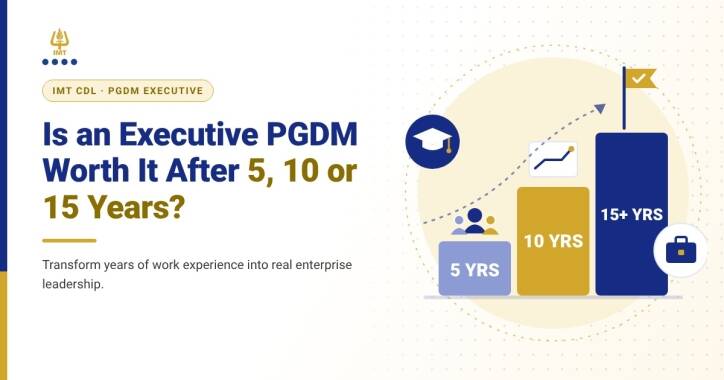
Is an Executive PGDM for Working Professionals Worth It After 5, 10 or 15 Years of Experience?
When you work at a company for years, hard work and technical skill do eventually pay off. If you get your tasks done well and deliver projects on time, people begin to notice. There comes a point where that is no longer enough. Around the 5th, 10th or 15th year of your career senior roles start asking for things you were never trained to do. They want you to understand budget sheets, coordinate between teams that don’t agree, manage business risks and make decisions when the path forward isn’t clear.
That’s why many professionals in the middle of their careers pause and ask: Is an executive PGDM worth it after years of experience? Can you just keep working longer hours and reach the top? Experience gives you knowledge about your industry. It doesn’t always teach you how to run a business. Let’s look at whether an executive PGDM makes sense for you based on where you’re right now in your career.
Why an Executive PGDM Delivers Different Value Across Experience Levels
A team lead with five years of experience faces very different problems than a senior manager with fifteen. An executive PGDM for working professionals only makes sense if it solves the challenge you are facing today.
1. After 5 Years: Moving from Task Execution to Team Leadership
By the five-year mark you likely know your domain well. The real challenge begins when you step into project leadership or start managing reports.
The Core Gap
- You know how to do your job well but you have little idea how other departments operate.
- You’re not yet confident about how different functions connect to drive revenue or enterprise value.
The ROI
An executive PGDM helps build an understanding of corporate operations, financial metrics and team management.
2.After 10 Years: Breaking Out of the Mid-Career Plateau
Ten years into your career reliable execution is already expected. You hit targets. Solve operational issues day after day.. This is often where managers hit a wall. People trust you to run the system but leadership hesitates to bring you into shaping future strategy.
The Core Gap
- You’ve been operating inside one function or department.
- After ten years in one company or sector your thinking reflects company habits than broader business strategies.
The ROI
- Enroll in an executive PGDM and join live discussions with peers from fields like IT, manufacturing, retail, finance and logistics.
- You study cross-industry case studies with professionals who have experience.
- You break out of thinking and learn to make smart data-backed strategic choices.
3.After 15+ Years: Strategy and Board-Level Decisions
At fifteen years or more basic management theory isn’t needed anymore. You don’t need beginner lessons on leading a team. Instead you’re dealing with business-unit direction transforming organizations handling operational risk and integrating AI into traditional systems.
The Core Gap
Transitioning from running one department to enterprise governance P&L ownership and CXO-level leadership.
The ROI
An advanced executive programme lets senior leaders test their thinking against market pressures. It offers frameworks to link everyday actions with long-term business goals.
Why Not Just Rely on Short Online Certifications?
Certifications help you learn specific tools like an analytics dashboard or prompt engineering. Leadership skills cannot be taught through multiple-choice quizzes. Leading a business demands debating ambiguous problems weighing trade-offs with incomplete data and defending decisions under pressure. That level of depth comes from cohort-based case discussions, interaction with experienced faculty and peer debates.
When Is an Executive PGDM Worth It
The decision becomes stronger when you can identify at one of these needs:
- Moving from executing tasks to managing teams
- Preparing for a promotion or greater responsibility
- Building better understanding across functions
- Strengthening expertise in a chosen area
- Switching to a new function or industry
- Improving analytical and strategic judgment
- Updating management knowledge for an AI-driven workplace
You should think twice or delay if:
- You don’t have a clear career goal
- You can’t commit time for regular study
- You expect the certificate alone to guarantee a promotion
- You haven’t checked the programme’s approval and academic structure
Choosing a Specialization Aligned with Your Next Role
Pick your specialization based on the responsibilities you plan to take on in the three to five years – not on what your past job titles were.
Strategy and Innovation: For managers aiming to lead business units turn around struggling divisions. Grow entire enterprises.
Business Analytics & AI: For leaders who need to turn data and predictive models into practical business moves.
Marketing: Focused on omnichannel growth, brand value, revenue systems and customer journey management.
Finance: Designed for professionals who will handle budgets, P&Ls, commercial risk and company valuation.
Operations: Built for those managing supply chains, agile logistics and scaling operations.
Human Resource: For executives shaping workforce plans, succession pipelines and organizational culture.
A 3-Step Decision Making Test Before You Apply
Before you apply run this self-check:
1. Map Your 3-Year Target: Define clearly the job title and daily duties you hope to hold in three years.
2. Isolate Capability Gaps: Identify where your experience falls short—whether in analysis, strategic planning or leading large teams.
3. Audit the Delivery Model: Confirm that the institution’s teaching methods, faculty background and peer group directly address your gaps.
IMT CDL’s 15-month PGDM Executive is built for working professionals. Delivered through interactive online weekend classes and focused campus immersions it offers an AICTE-approved curriculum, across six functional pathways, helping you transform years of work experience into real enterprise leadership.
Not sure which track fits your career goals? Take a look at the 6 executive PGDM specialisations, or set up a quick 1-on-1 chat with an advisor to find the right path for your experience.
Frequently Asked Questions
If I have 10+ years of industry experience won't an executive course repeat what I already do at work?
No. 10 years experience in management is already strong but methods are usually tied to the current company playbook. Executive PGDM does not re-teach supervision. Executive PGDM challenges company habits by exposing experience to how leaders in industries tackle capital allocation, cross-functional risk and enterprise strategy. Executive PGDM bridges the gap between running departments well. Steering broad business growth.
At 15+ years of experience will the cohort and curriculum match my seniority level?
Yes. Executive cohorts are curated for working professionals with industry mileage, not fresh graduates. For professionals with 15+ years of experience, the curriculum skips introductory supervision. Focuses directly on enterprise governance, digital disruption, multi-department leadership and high-level strategic decisions. Experience gains knowledge alongside peers who bring equal depth and real business challenges to classroom discussions.
How does an executive PGDM help break the -career plateau compared to simply changing jobs?
Switching companies usually gives salary hike but often end up doing the same functional work, in a new office. Executive PGDM breaks career plateau by solving actual reasons professionals get stuck: lack of cross-functional and strategic fluency. Of moving sideways into another execution role Executive PGDM equips experience to take on P&L ownership, lead multi-department teams and qualify for general management or director-level positions that require broad business vision.

